Identifying Common Air Distribution Symptoms
-
Uneven Thermal Zoning: Multi-level structures or expansive floor plans often experience hot or cold spots. This is usually driven by improper duct sizing, unbalanced branch dampers, or static pressure drops over long duct runs.
-
Acoustic Disturbances: Banging or popping sounds indicate thermal expansion and contraction within thin-gauge metal ducts, or sudden pressure shifts when the blower engages. Whistling or loud rushing sounds point to air leaks, loose connections, or undersized supply registers forcing air through narrow openings at high velocities.
-
Restricted Airflow (CFM Drops): Weak airflow at the supply registers reduces the total cubic feet per minute (CFM) of air delivered to the space. Left unaddressed, restricted airflow starves the system, causing the evaporator coil to freeze in cooling mode or the heat exchanger to trip high-limit switches in heating mode.
Systematic Diagnostic and Troubleshooting Protocols
Visual and Structural Inspection
Static Pressure and Airflow Testing
-
Total External Static Pressure (TESP): Measured using a dual-port digital manometer with static pressure probes inserted into the supply and return plenums. High static pressure (typically exceeding 0.5 inches of water column in residential systems) indicates severe restrictions such as dirty filters, undersized ductwork, or restrictive coils.
-
Anemometers and Flow Hoods: Hot-wire anemometers measure air velocity within ducts, while capture hoods (balometers) fit over registers to read exact CFM delivery per room, allowing technicians to map airflow imbalances across the property.
Advanced Thermal and Leak Diagnostics
-
Thermal Imaging: Technicians utilize infrared cameras to detect temperature anomalies along insulated duct runs, identifying hidden air leaks, unconditioned attic losses, or disconnected branch lines inside wall cavities.
-
Duct Pressurization Testing: Using a duct blower system, technicians pressurize the duct network to quantify total duct leakage (CFM25) and pinpoint exact tear or connection failures using non-toxic theatrical smoke.
Targeted Remediation and Solutions
Ductwork Sealing and Structural Repair
Airflow Balancing and Zoning Adjustments
Component Modernization
-
Variable-Speed Blower Motors: Replacing single-speed PSC motors with electronically commutated motors (ECMs) allows the system to automatically adjust fan speed to maintain consistent CFM despite static pressure variations.
-
Smart Thermostats and Motorized Dampers: Implementing multi-zone control boards paired with motorized dampers ensures air is dynamically directed only to occupied areas, lowering energy consumption.
Long-Term System Impact and Efficacy
-
Energy Efficiency: Sealing leaky ducts and optimizing fan performance can improve overall HVAC operating efficiency by up to 30%, directly reducing monthly utility costs.
-
Equipment Longevity: Normalizing static pressure reduces thermal and mechanical stress on major components, preventing premature compressor failure, motor burnout, and cracked heat exchangers.
-
Enhanced Indoor Environmental Quality (IEQ): Properly sealed and balanced systems prevent unconditioned, dusty attic or crawlspace air from being drawn into the breathing zone, maintaining stable humidity levels and consistent filtration.
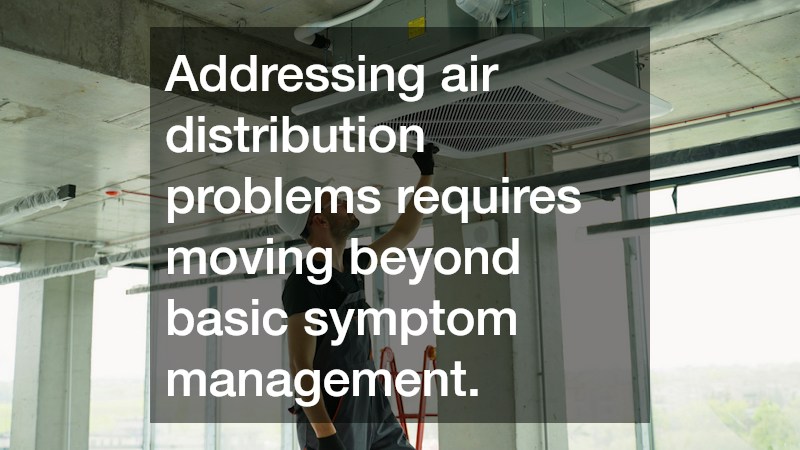
Addressing air distribution problems requires moving beyond basic symptom management to perform comprehensive, data-driven diagnostics. By measuring static pressure, evaluating CFM delivery, and utilizing thermal imaging, HVAC companies in Henderson, KY isolate the root causes of airflow inefficiencies. Implementing proper duct sealing, mechanical balancing, and component modernization restores precise climate control, maximizes energy efficiency, and protects the long-term reliability of the entire HVAC asset.